
Interactive books students can walk inside
Let them walk inside the book they’re reading.
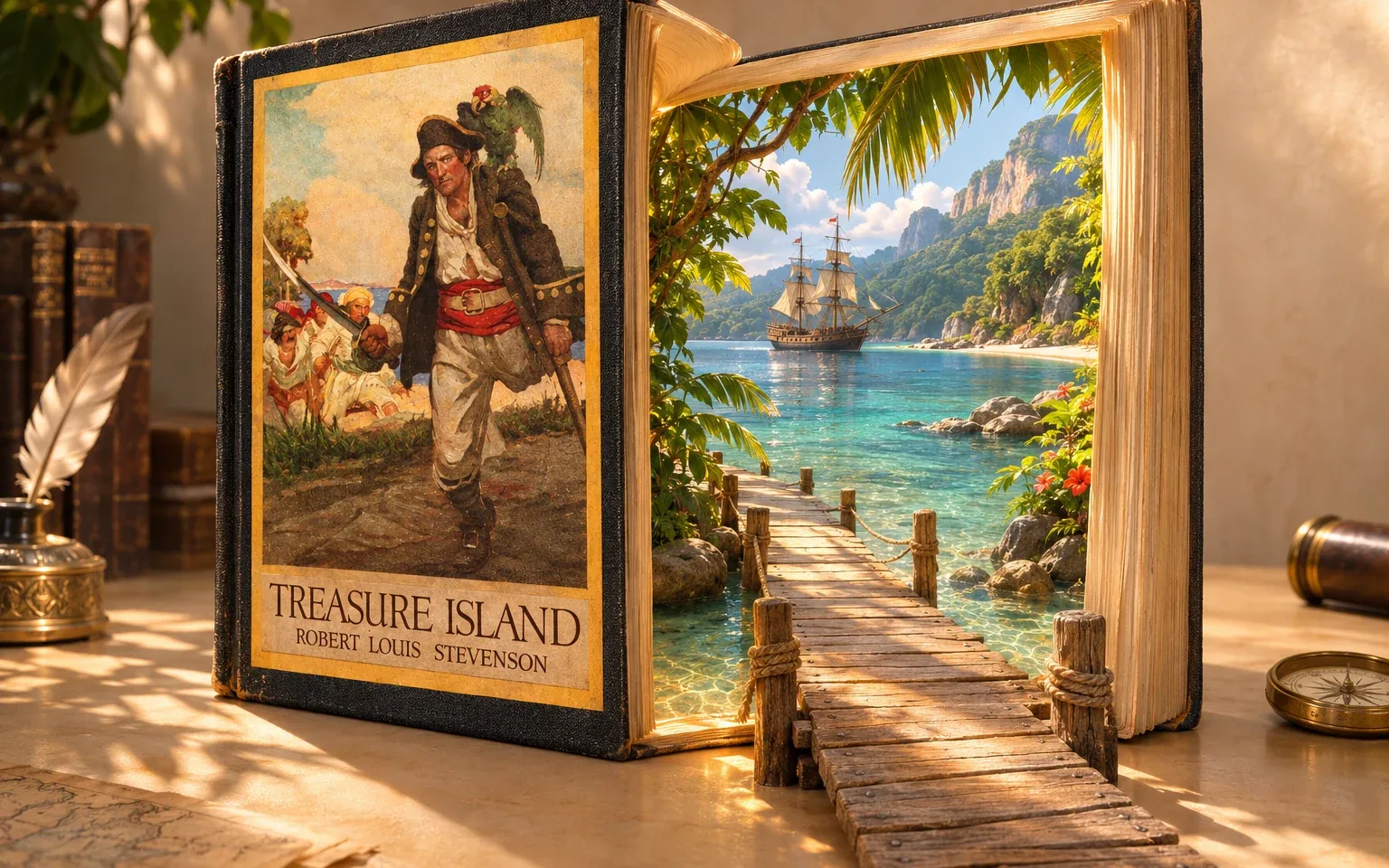
After the first chapter of Treasure Island, a student walks into the Admiral Benbow inn and takes a close look at the captain’s coat. They match the clues they find to lines in the book. Then they come to class with an idea.
InsideTheBook
In InsideTheBook, students read the book, then step into the places where the story happens. The first book is Treasure Island. Students explore the Admiral Benbow inn, the harbor, the ship, and the island, and match the clues they find to lines in the book. Then, in class, they discuss what they read and what they found.
- Format
- Tablet-first app; original English text, explorable scenes, and short films
- Who it’s for
- Middle and high school (grades 6–12); reading programs and book clubs
- In your school
- English reading class or book club; students read and explore, the class discusses
- Outcome
- Notes backed by quotes from the book, ideas written in English, and a discussion question brought to class
How it works
The chapter ends. The door opens.
- 1
Read the chapter
Students read the chapter in the original text. Before they start, they think about a short question. If they get stuck, they check the chapter guide cards.
- 2
Step into the story
After a short film scene, the student takes control. They explore the inn, the harbor, the ship, or the island on foot and record observations grounded in the book.
- 3
Write your idea
They bring their observations together into one interpretation. In the thinking workshop, they write their view of a character in English and back it up with a moment from the book.
- 4
Discuss in class
The club card already holds their idea, the moment they picked from the book, and their question. In class, the group uses these to discuss the characters’ choices.
What’s included
The novel, now at their fingertips.
Original text, with support close by
Treasure Island is read as Stevenson wrote it. Tap an underlined word to see its meaning and the sentence it appears in. Paragraphs can also be played aloud.
Scenes you walk through
The inn, the shore, the harbor, the ship, the island. Students walk with touch controls, look around, and move close to an object to examine it.
Short films, English narration
Selected moments open with a short film and English narration. Subtitles can be enlarged and the narration replayed. The continue button is always in the student’s hands.
On the trail of clues
At the inn, students examine the telescope, the door, and the captain’s coat. They record observations from the book and combine at least two into one interpretation.
Thinking workshop
Notice it, trace it, if you were them, in your own words. With these four steps, students write an opinion about a character in English. They get help if they ask for it, or move ahead on their own.
Notebook and club card
Notes, words, and ideas build up in the notebook. The club card gets the idea, a moment from the book, and a question ready for discussion.
Who gains what
Students come to class with something to say.
Teacher
Chooses the chapter to read and the discussion question. Students arrive with their idea, a moment from the book, and their question ready on the club card, so discussion starts in the first minute.
Student
Reads the chapter, explores the inn and the ship, records clues, and writes an opinion about a character in English. When they speak up in class, they have evidence from the book to back it.
Class or book club
Discusses the characters’ choices through moments picked from the book. Puts different readings of the same scene side by side and hears who thinks what, and why.
FAQ
Questions before you decide.
What language do students read the book in?
They read the original English text. Tapping certain words shows their meaning and the sentence they appear in. This is not a simplified graded reader. Students read exactly what Stevenson wrote.
Which books are available?
The first book is Robert Louis Stevenson’s Treasure Island. The original text of all 34 chapters is in the app. Scenes and films cover selected moments from the book.
Are the visuals and films part of the book?
No. The scene visuals and short films are AI-generated visual interpretations of the novel, and the app labels them that way. The text students read is the original text from Project Gutenberg.
Where is student work saved?
In My Notebook. Notes, words, and ideas are collected there and can also be downloaded as a file.
Do students have to speak?
No. Students can answer questions in a scene by speaking or typing, or skip the question if they want. The microphone turns on only when they tap it.
Also worth a look
These can help as well.
Let’s talk
Let’s talk about adding it to your reading program.
Let’s plan together which classes and chapters to start with, and how your teachers will use it in class.